Stone calculator for Kansas
Find tonnage for graded stone sizes, including 3/8 inch chips and railroad ballast.
Enter your project dimensions
Use this calculator to estimate crushed stone by the ton. Most grades convert at about 2,800 lb for each cubic yard, or 1.4 tons per yard. It accounts for the specific weight of the twelve available graded materials, starting with 3/8 inch chips and extending to 2.5 inch railroad ballast. A contractor may begin with a spec number, while a homeowner may start with the project. The information below connects either starting point to the appropriate stone.
How to calculate
- For pads and driveways, multiply length by width in feet. For drains, multiply the trench length by its width.
- Set the depth for the layer's purpose. Finish material is 2 to 3 inches, base material is 4 inches, and French drains need 12 inches or more.
- Divide cubic feet by 27 to get cubic yards. Multiply yards by 1.4 for tons of typical crushed stone.
Weights by stone type
| Product | Weight per cubic yard | Tons per yard |
|---|---|---|
| #57 / #67 / 3/4" crushed stone | ≈ 2,800 lb | 1.40 |
| #89 / #8 / 3/8" chips | ≈ 2,800 lb | 1.40 |
| Stone screenings / dust | ≈ 2,900 lb | 1.45 |
| Crusher run / road base | ≈ 3,000 lb | 1.50 |
| #4 stone / railroad ballast | ≈ 2,900 lb | 1.45 |
| Rip rap | ≈ 3,100 lb | 1.55 |
| Depth | 1 cubic yard covers | 1 ton covers |
|---|---|---|
| 2 inches | 162 sq ft | ≈ 116 sq ft |
| 3 inches | 108 sq ft | ≈ 77 sq ft |
| 4 inches | 81 sq ft | ≈ 58 sq ft |
| 6 inches | 54 sq ft | ≈ 39 sq ft |
Understanding size grades
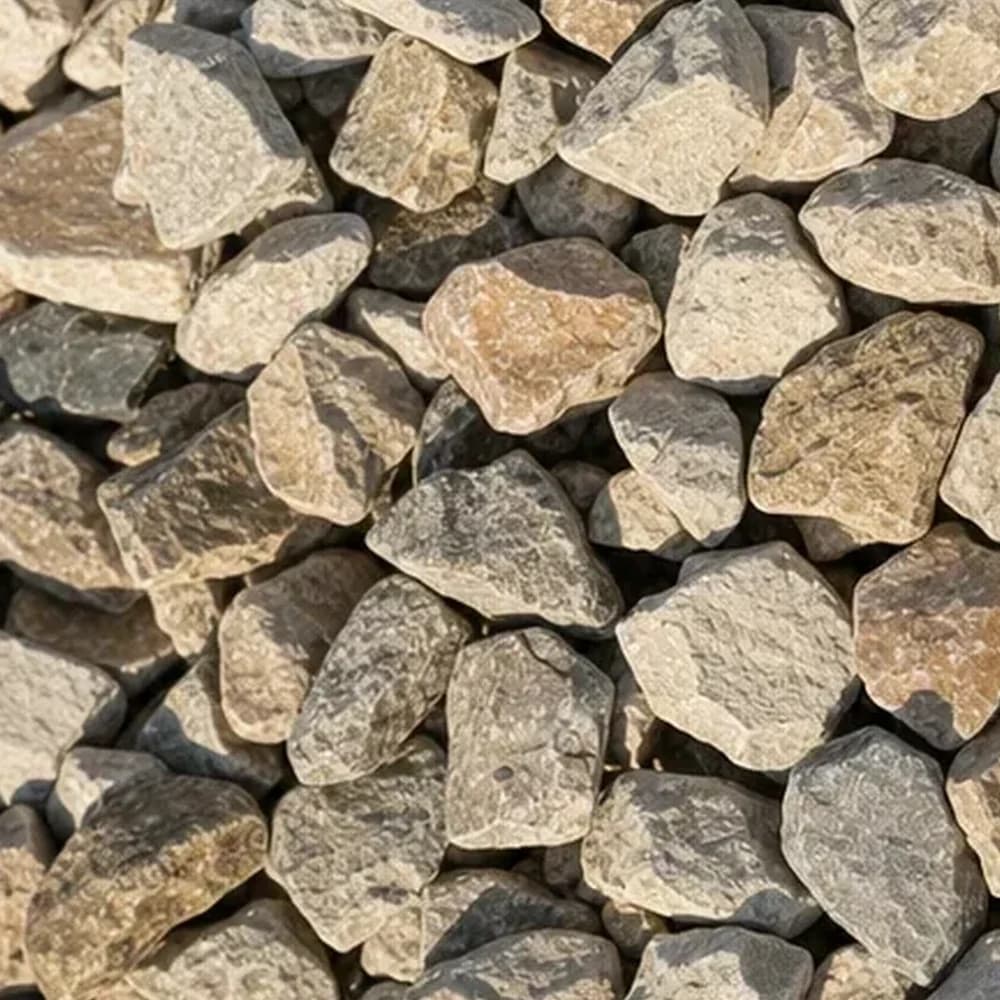
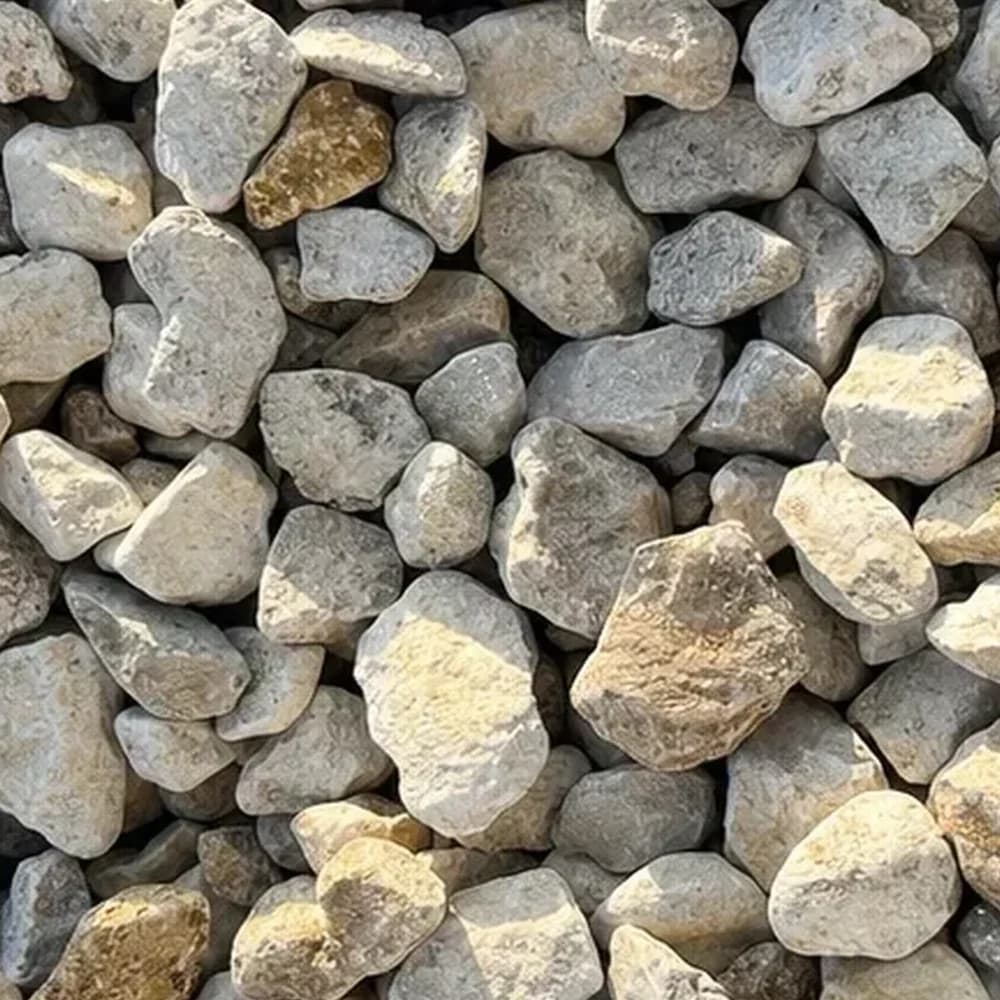
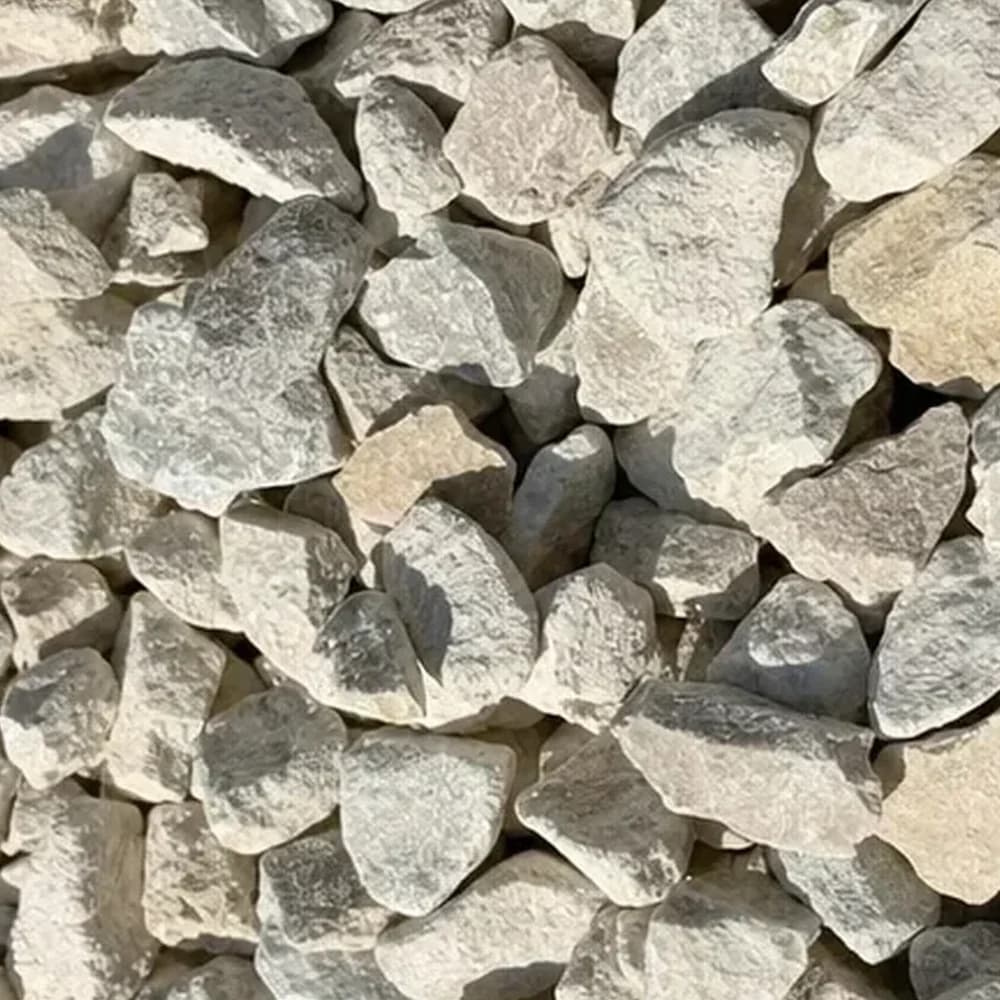
Stone grade numbers describe rock-size ranges, with lower numbers representing larger pieces. #4 is 1 to 2 inches. For general drainage, driveways, and concrete jobs, #57 measures 3/4 to 1 inch. #67 is finer at 1/4 to 3/4 inch and is commonly used around pipe bedding. #8 is about 3/8 to 1/2 inch. #89 ranges from 3/8 inch down to fines, and both can serve paver joints or finished surfaces. Screenings combine dust with small chips and form a firm bed for screeding after compaction. Railroad ballast uses heavy, angular 1 to 2.5 inches rock for drainage and load support below tracks and equipment pads.
Clean stone or fines: choose the right type
This page groups material into two types. Washed clean stone, including #57, leaves space for water to pass and suits drainage. Crusher run and road base contain fines that bind together when compacted, making them suitable for base layers. Using each in the wrong place causes problems: crusher run can trap water in a French drain, while a #57 driveway base can continue to move. When plans or permits list a gradation, use that listed specification. Send the line item through our contact form when the name is unclear. "3/4 clean" and "#57" can be names for the same material.
Common stone quantities
| Project | Typical size | Depth | Volume | Weight |
|---|---|---|---|---|
| French drain | 30 ft x 12" x 12" | 12" | 1.1 yd³ | 1.6 tons |
| Pipe bedding (#67) | 40 ft x 18" wide | 6" | 1.1 yd³ | 1.6 tons |
| Retaining-wall backfill | 30 ft x 18" wide | 24" | 3.3 yd³ | 4.7 tons |
| Construction entrance (#4) | 40 x 12 ft | 6" | 8.9 yd³ | 12.9 tons |
| Dog run | 15 x 8 ft | 3" | 1.1 yd³ | 1.6 tons |
| Shed pad top course | 10 x 12 ft | 2" | 0.7 yd³ | 1 tons |
Example: a 30-foot French drain
A 30 feet trench that is 12 inches wide and 12 inches deep contains 30 cubic feet. That works out to 1.1 cubic yards, or 1.6 tons of #57. The 4-inch pipe takes up only about 0.1 yards, so order all 1.6 tons and place the slight remainder at the outfall. Before adding stone, line the trench with non-woven fabric. It keeps soil out of the open spaces the drain needs.
Two ways to avoid ordering errors
- Check the specification first and then compare the local label. Crusher run, crush and run, 1 Inch Minus, screened base and shoulder rock can describe one material. #57 and "57s" mean the same stone.
- Rolled angular material can compact by 5 to 10%. Use the calculator's extra-percent toggle for ordinary settling. Engineered base projects follow the specified compacted depth.
- A paver installation gets its support from compacted base stone. Use screenings or concrete sand only for the thin leveling layer. Do not place pavers on dust alone where soil is soft.
- Calculate the trench volume without subtracting the pipe. Pipes under 6 inches generally displace less than a wheelbarrow load.
Crushed stone facts
What does crushed stone weigh per yard?
What area will a ton of #57 cover?
How are #57, #67 and #89 different?
How deep should driveway stone be?
Stone dust or sand beneath pavers?
Which stone works for a French drain?
Will crushed stone compact?
How is railroad ballast used beyond rail lines?
Other calculators
Stone by specification
Twelve graded stone products, priced per ton, with free delivery across Kansas.